
POME Oil (Palm Oil Mill Effluent Bio-Oil)
Industrial Wastewater Bio-Lipid Recovery for Advanced Biofuels & Biogas Feedstock
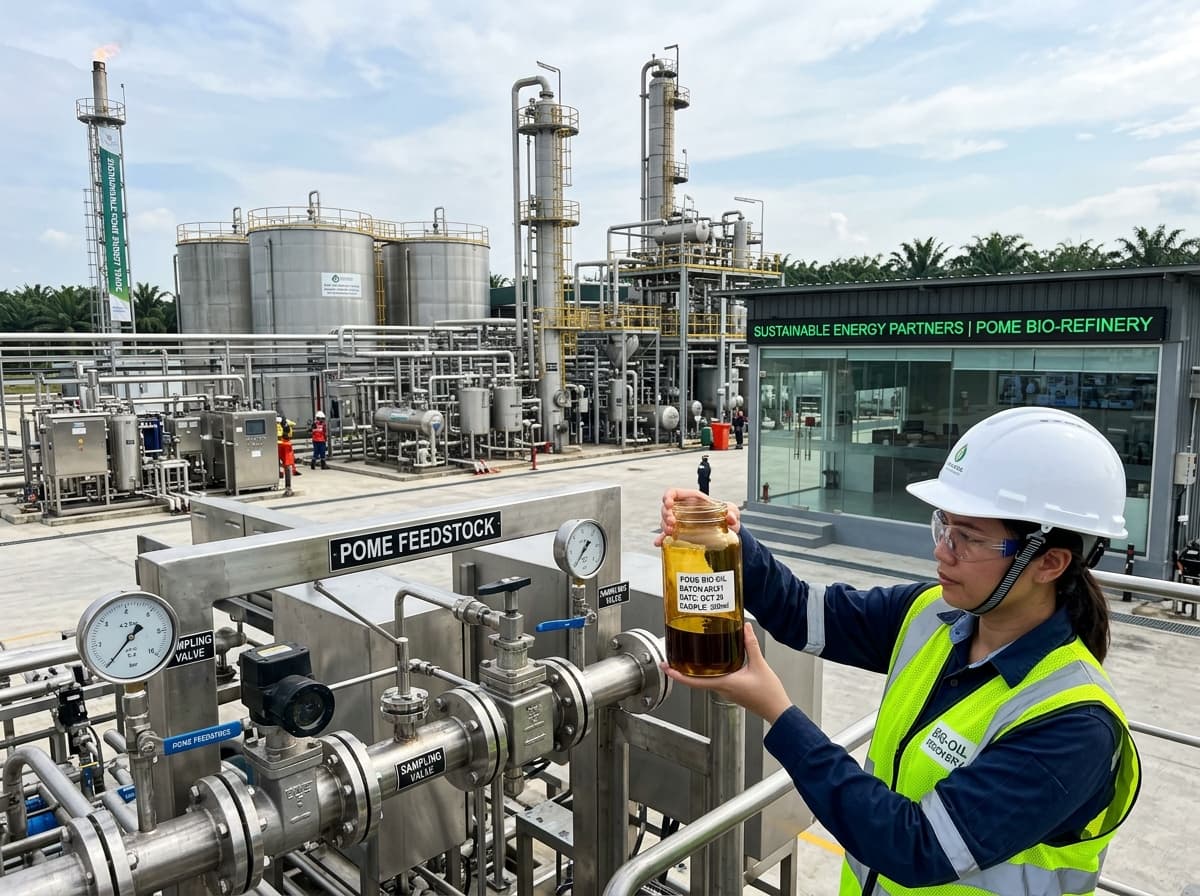
Palm Oil Mill Effluent (POME) Oil is a high-value industrial bio-oil recovered from the treatment ponds of crude palm oil extraction mills. It serves as an advanced, non-crop second-generation feedstock for renewable diesel and biochemical production.
About POME Oil (Palm Oil Mill Effluent Bio-Oil)
During the wet milling of fresh palm fruit bunches, substantial quantities of process water and wastewater are generated. Traditionally treated in anaerobic stabilization lagoons, modern palm mills employ skimmers, centrifuges, and recovery systems to capture the residual floating lipid layer known as POME Oil or Sludge Palm Oil. Because it originates from mill wastewater without competing with food crops or arable land, POME Oil qualifies as an advanced low-ILUC (Indirect Land Use Change) bio-feedstock under international renewable energy frameworks. United Saud Malaysia coordinates the commercial supply of recovered POME oil to industrial off-takers.
Key Quality Highlights & Characteristics:
Procurement SummaryRenewable Feedstocks
Available Product Grades
Tailored to meet regional climate expectations, food industry melting targets, or industrial processing thresholds.
Standard Industrial POME Oil
Dark brownish bio-oil with Free Fatty Acids typically between 30% and 50%, moisture ≤ 3%, suitable for specialized bio-refinery pre-treatment units and biogas plant supplementation.
Upgraded / Acid-Reduced POME Bio-Lipid
Partially washed and de-moisturized grade tailored for advanced biodiesel transesterification systems requiring controlled moisture levels below 1.5%.
Standard Technical Specifications
Commercial export parameters aligned with standard Malaysian industry benchmarks.
| Analytical Parameter | Standard Commercial Limit | Official Test Method |
|---|---|---|
| Free Fatty Acids (FFA as Palmitic) | 30% – 55% typical | AOCS Ca 5a-40 |
| Moisture & Volatiles (M&V) | 2.0% – 3.0% Max | AOCS Ca 2c-25 / Karl Fischer |
| Total Fatty Matter (TFM) | 95.0% Min | Standard Titration |
| Insoluble Impurities | 0.5% – 1.0% Max | Solvent Extraction |
| Iodine Value (Wijs) | 48 – 56 | AOCS Cd 1d-92 |
| Appearance | Dark viscous brown liquid/paste at ambient temp | Visual Inspection |
Commercial Applications
Advanced Second-Generation Biofuels (HVO / SAF)
Refined in high-pressure hydroprocessing facilities to produce drop-in paraffinic fuels with double-counting GHG credits in regulatory carbon markets.
Anaerobic Co-Digestion for Biogas / Biomethane
Utilized as a high-calorific co-substrate to boost methane yield in industrial anaerobic digesters and renewable natural gas (RNG) plants.
Industrial Soap & Technical Oleochemicals
Low-cost feedstock for dark laundry soap manufacture, metallic stearates, and technical-grade fatty acid distillation.
Boiler Fuel / Bio-Burner Oil
Co-fired in heavy industrial boilers and thermal fluid heaters as an alternative to fossil-based heavy fuel oil (HFO).
Export Packaging Formats
Bulk Flexitanks (equipped with thermal pads)
20,000 to 22,000 kg per 20' ContainerInternational maritime delivery to industrial energy processors.
ISO Tank Containers
21,000 to 24,000 kgHigh-spec multimodal transit with dedicated heating coils.
Bulk Liquid Coastal Barges / Tanker Parcels
500 to 3,000 Metric TonsDirect delivery between regional coastal terminals and deepwater bio-refineries.
Shipment & Transit Considerations
- Non-Food Classification: Explicitly designated as waste residue under maritime hazardous/non-hazardous classification. Prohibited from any food or animal feed applications.
- Viscosity & Temperature: Because POME Oil contains high levels of saturated free fatty acids, it solidifies at temperatures below ~40°C. Flexitanks must be connected to heating coils/pads at destination prior to discharge.
- Inspection: Pre-loading sampling by independent marine surveyors to ensure compliance with agreed TFM, FFA, and M&I tolerances.
Export Quality & Shipping Dossier
- Independent Marine Surveyor Certificate (SGS, CCIC, or equivalent)
- Mill Origin Declaration (verifying genuine effluent recovery source)
- Safety Data Sheet (SDS) for Industrial POME Oil
- Export Customs Declaration (Malaysian Customs Department)
- Commercial Clean on Board Ocean Bill of Lading
Frequently Asked Questions: POME Oil (Palm Oil Mill Effluent Bio-Oil)
How is POME Oil recovered from palm mills?
Palm Oil Mill Effluent (POME) is the liquid byproduct discharged during the sterilization, clarification, and purification stages of fresh fruit bunch processing. Before the effluent enters anaerobic treatment lagoons, residual oil that floats to the surface is recovered using oil traps, disc-stack centrifuges, or dissolved air flotation (DAF) systems.
Why is POME Oil favored by renewable fuel refiners?
Because it is derived from industrial wastewater without utilizing additional arable land or competing with the human food chain, it qualifies as an advanced, high-GHG-saving feedstock under European (RED II/III Annex IX-A) and international low-carbon fuel standards.
Other Confirmed Commodities
View All Products

Ready to Coordinate Your Next Malaysian Commodity Consignment?
Submit your product grade, required packaging, target quantity, and destination port. Our international sales desk will review your specifications and provide a verified commercial quotation.